
Why Does Lower Back Pain Keep Coming Back?
Back Pain · Salisbury, MA
Why Does My Lower Back Pain Keep Coming Back?
You had a bad week. You rested, took something for it, maybe stretched or got a massage, and it settled down. Six weeks later you bent over to grab a laundry basket and you are right back where you started. If that cycle sounds familiar, there is a reason for it, and it usually has nothing to do with what you did on the day it flared.
Most people we see in Salisbury have been through this loop three or four times before they call anyone. The pain always quiets down eventually, so it never feels serious enough to look into. Then it comes back a little sooner than last time, and stays a little longer.
Why does back pain go away and then return?
Pain is not a great measuring stick. It is a warning signal, and warning signals shut off well before the thing they were warning you about is resolved.
Think about a sprained ankle. The sharp pain fades in about a week. The ligament is nowhere near healed at a week, which is why people who go back to basketball on day eight roll it again. Your low back works the same way. Inflammation settles, the muscles calm down, and you feel fine while the underlying mechanics are exactly where they were.
So the flare-up is not the problem. The flare-up is the alarm going off on a problem that has been sitting there quietly, and the laundry basket just happened to be the last straw that week.
What is actually causing the pain to keep returning?
In our experience there are four common reasons, and plenty of people have more than one going on at once.
1. A disc is involved
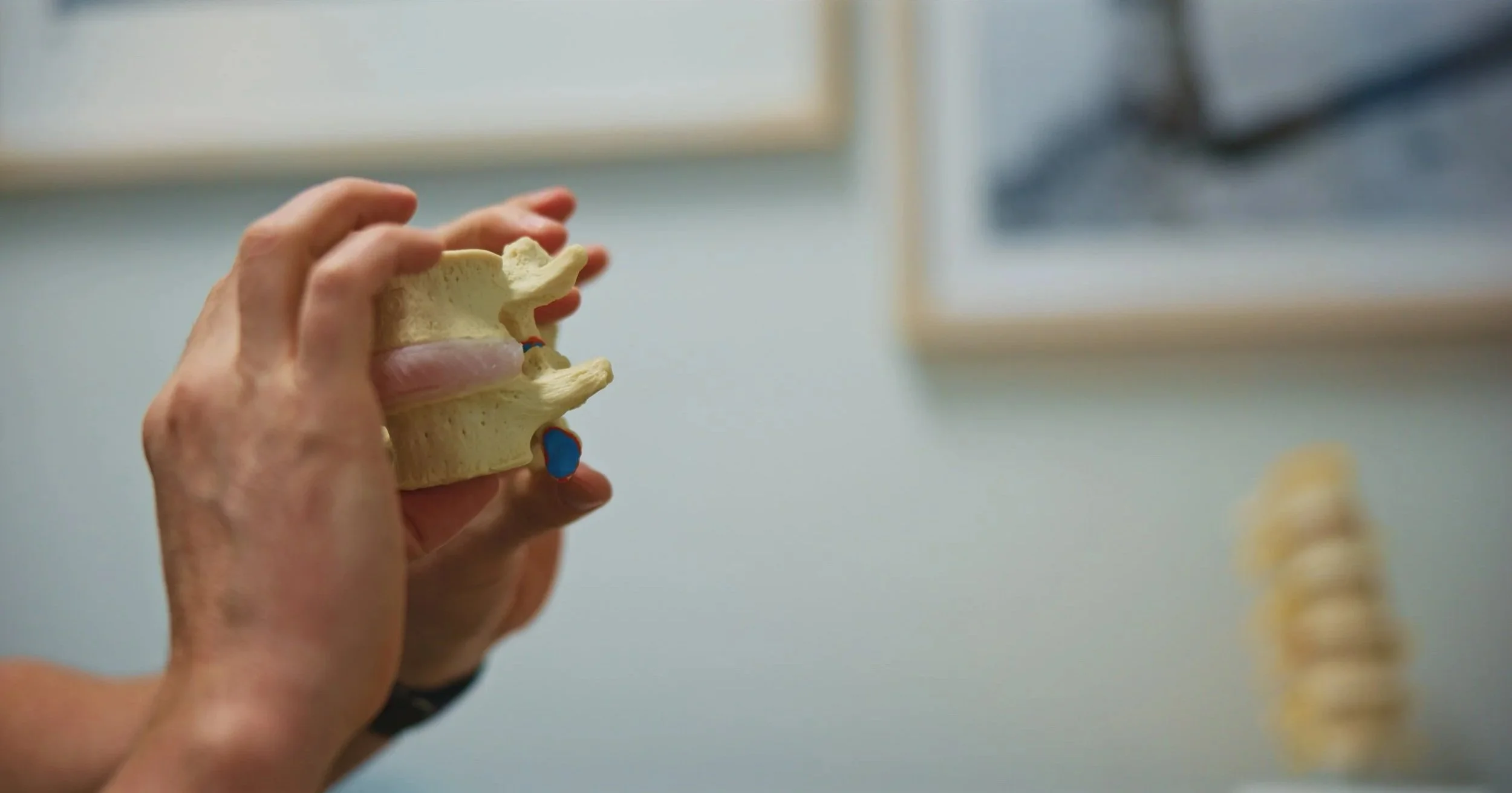
Discs sit between the vertebrae and act as spacers and shock absorbers. When one bulges or herniates, material presses against a nerve root. Pressure eases when you lie down or change position, so the pain lets up. Load the spine again and the pressure returns.
The tell is often what happens in the leg. Pain, numbness, tingling or weakness that travels below the knee usually means a nerve is involved rather than a muscle. That pattern shows up on our sciatica treatment and herniated disc care pages, and it is the group that responds well to non-surgical spinal decompression, which unloads a targeted segment rather than pulling on the whole spine.
2. The curve in your spine has changed
A healthy low back carries a gentle forward curve. That curve is what distributes load across the discs and joints evenly. When it flattens out, which happens gradually with years of sitting or after an old injury, load stops being shared. A few segments start absorbing what the whole region used to handle.
You cannot feel a curve change. It does not hurt. It shows up on an X-ray, and it explains why the same one or two spots flare over and over while the rest of your back is fine.
3. The muscles that stabilize you switched off
After an episode of back pain, the deep stabilizing muscles around the spine often stop firing properly, and that does not always come back on its own once the pain settles. Bigger muscles take over the work and fatigue faster, which is why people describe their back as feeling unreliable long after it stopped hurting.
This is the piece that rest alone never fixes. Rest calms the pain and leaves the coordination problem in place.
4. Nothing about your day has changed
Whatever loaded your back into a flare-up the first time is probably still in your routine. The commute down 95, eight hours at a desk, a job that has you lifting and twisting, sleeping on a mattress you have had since 2015. None of these are dramatic. They just keep applying the same input.
A quick check. Write down the last three times your back went out. If the gaps between them are getting shorter, or each episode is lasting longer than the one before, that trend matters more than how bad any single episode felt.
Is it normal for back pain to come and go for years?
Common, yes. Normal, no.
Recurrence is extremely common, which is why so many people end up describing their back as something they manage rather than something they sorted out. But common and normal are different things, and a pattern that repeats on a shortening cycle is worth having looked at rather than waited out.
The people who break the cycle are almost always the ones who found out what was driving it. That is a different question from what makes it feel better, and it needs different information to answer.
When should recurring back pain get looked at?
Sooner than most people go. Worth getting examined if any of these apply:
- The episodes are getting closer together or lasting longer
- Pain, numbness or tingling travels into the buttock, thigh, calf or foot
- You have noticed weakness, like a foot catching on stairs or a leg giving way
- The pain is worse first thing in the morning or after sitting for a stretch
- You have stopped doing something you used to do because you are worried about your back
That last one is the one people skip over, and it is the one that tends to matter most to them a year later. Changing your life around a back you do not trust is a bigger cost than the back pain itself.
Some symptoms need immediate medical attention rather than a chiropractic visit. Loss of bladder or bowel control, numbness through the groin or inner thighs, or significant weakness in both legs means the emergency room, today.

What does correcting it actually involve?
It starts with an examination rather than a treatment. We look at posture, range of motion, orthopedic and neurological testing, and X-rays when they are indicated, because the curve question and the disc question both need imaging before anyone can answer them.
From there you get told what we found and whether we think it can be corrected. If a disc is the driver, decompression usually has a role. If the spine has lost its normal curve, that is a structural piece we work on directly alongside chiropractic care. If the stabilizers need retraining, you get specific work to do at home using systems like McKenzie, McGill and Denneroll supports. Most people need some combination.
We track it with a Spinal Health Score, which measures posture, range of motion and nerve function and gets re-measured as you go. That way progress is something you can look at, rather than something you guess at based on how a given week felt.
And if we look at your case and think you would be better served somewhere else, we say so. Not every back needs what we do.
What can I do in the meantime?
None of this replaces getting examined, and none of it addresses a disc or a curve. But it does reduce how often you get flared, and that is worth having while you sort out the rest.
- Break up sitting. Get up every forty-five minutes or so. It is the frequency that matters, not what you do when you stand.
- Change how you lift, not how much. Hinge at the hips, keep the load close, turn your feet instead of twisting your back. The laundry basket injuries almost always involve a twist.
- Walk. Regular walking is one of the better things going for low backs, and it costs nothing. The rail trail and the Salisbury beach reservation are both flat and easy on it.
- Look at your sleep setup. A pillow between the knees on your side, or under the knees on your back, keeps the low back closer to neutral for seven hours.
- Go easy on long stretching sessions during a flare. When a nerve is irritated, aggressive hamstring stretching often makes the next day worse.
The short version
Back pain that keeps returning is usually pointing at a mechanical cause that never got addressed. Discs, spinal curve, stabilizer function and daily load are the usual suspects. Pain settling down does not mean the cause resolved, and each round tends to arrive a little sooner than the last. Getting it examined properly tells you which of those four is driving yours, and whether it can be corrected.
Find out what is driving yours
The New Patient Special is a consultation and assessment with the doctor. You leave knowing what we found and whether we can help. We see patients from Salisbury, Newburyport, Amesbury, Seabrook and across the North Shore.
Or call or text the clinic at (978) 961-9099. Insurance questions? Every plan is different, so we do a free benefit check at your first visit. Financing available.
More on chronic back pain relief at our Salisbury clinic, or browse the full list of conditions we treat. Patients coming from across the river can find directions and details on our chiropractor in Newburyport page.
