
Focused Shockwave · Salisbury, MA
Focused shockwave therapy in Salisbury, MA for chronic tendon and joint pain
Plantar fasciitis, tennis elbow, rotator cuff pain, and other injuries that stopped responding to rest and stretching. Focused shockwave restarts healing at the depth where the damage actually sits, in weekly sessions that take minutes.
Book New Patient Special Call (978) 961-9099★★★★★ 5.0 average rating across 150+ patient reviews
Newman Chiropractic provides focused extracorporeal shockwave therapy (ESWT) in Salisbury, MA, serving Newburyport, Amesbury, Seabrook, and the North Shore. Focused shockwave delivers 1,000 precise acoustic pulses per treated region to restart healing in chronic tendon and soft-tissue injuries, including plantar fasciitis, tennis elbow, rotator cuff pain, and Achilles tendinopathy. Sessions take 5 to 10 minutes per region, once a week, with a standard course of 8 sessions over 2 months. Every patient's care begins with a consultation and assessment with the doctor.
How it works
What is focused shockwave therapy and how does it work?
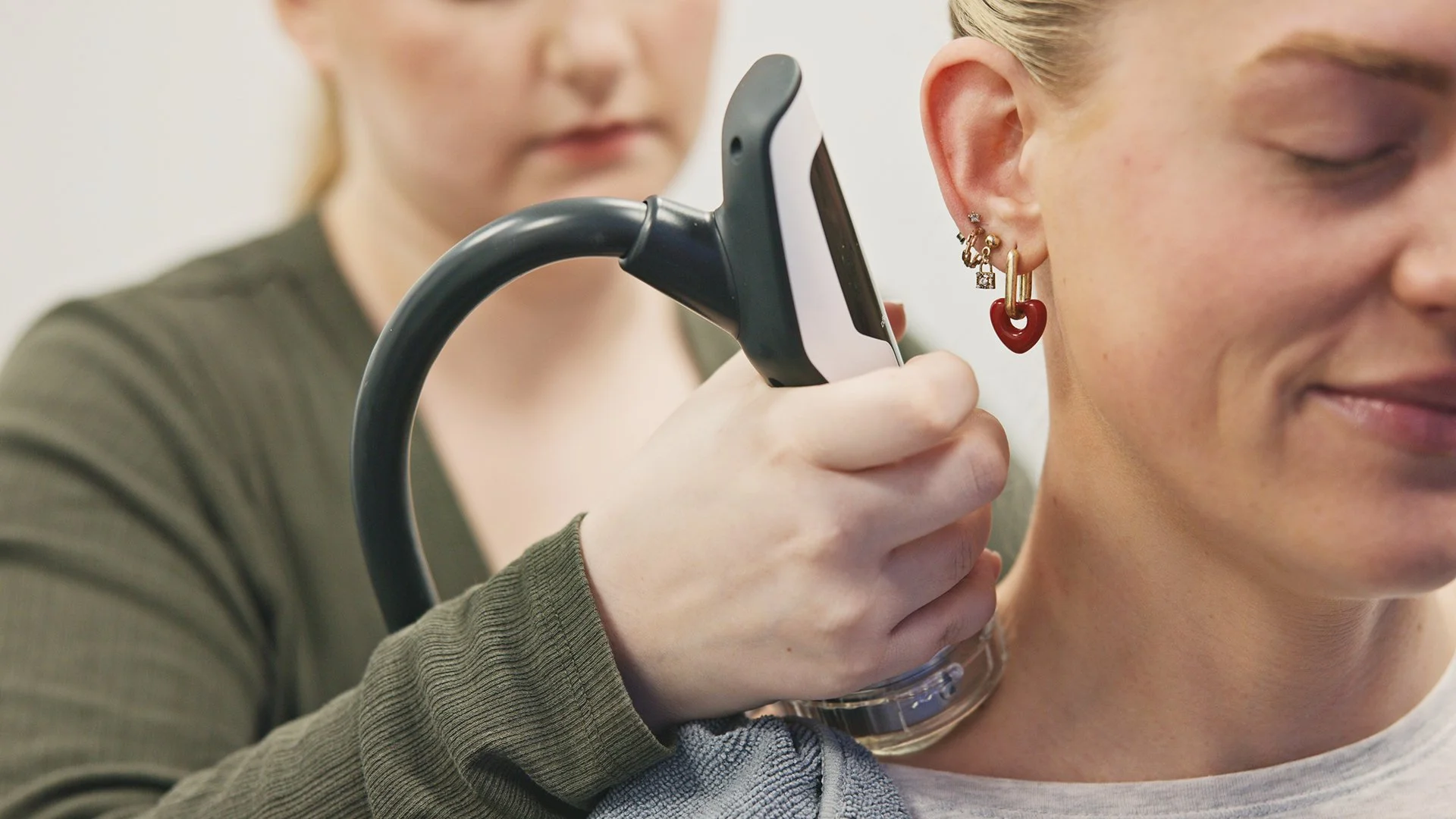
Focused shockwave sends targeted acoustic pulses into a specific spot of damaged tissue. Those pulses increase circulation, break down dysfunctional scar tissue, and stimulate collagen production, which tells a stalled injury to start healing again. It is the same technology used in professional sports rehab rooms, and it earns its place there by reaching what hands and surface treatments cannot.
Depth is the whole story. Radial devices spread their energy wide and shallow, so most of it lands near the skin. Focused shockwave concentrates the pulse at a set depth, in the tendon or tissue that is actually injured. That precision is why it works on problems that have hung around for months or years.
Chronic injuries are usually stuck, and stuck tissue does not respond to rest. It needs a reason to remodel. Focused shockwave gives it one.
What it treats
What does focused shockwave treat?
Focused shockwave is built for soft-tissue problems that have outlasted rest, ice, stretching, and massage. The most common cases we treat with it:
Plantar fasciitis
Heel pain that screams on the first steps of the morning and never fully goes away. Shockwave targets the irritated fascia right where it attaches.
Tennis and golfer's elbow
Tendon pain on the outside or inside of the elbow that flares with gripping, lifting, or a day at the keyboard.
Rotator cuff and shoulder pain
Deep shoulder irritation that limits reaching and overhead work, including calcific buildup in the tendon.
Achilles and patellar tendon pain
Stubborn tendinopathy in runners, lifters, and anyone on their feet all day.
Hip and IT band discomfort
Outer hip and thigh pain from tendon and soft-tissue irritation that stretching alone will not resolve.
Scar tissue and chronic tightness
Long-standing muscle restriction and adhesions that keep pulling you back into the same pain pattern.
If your pain traces back to the spine instead of a tendon, a different tool may lead your care. Start with the full list of conditions we treat.
What to expect
What happens during a shockwave session?
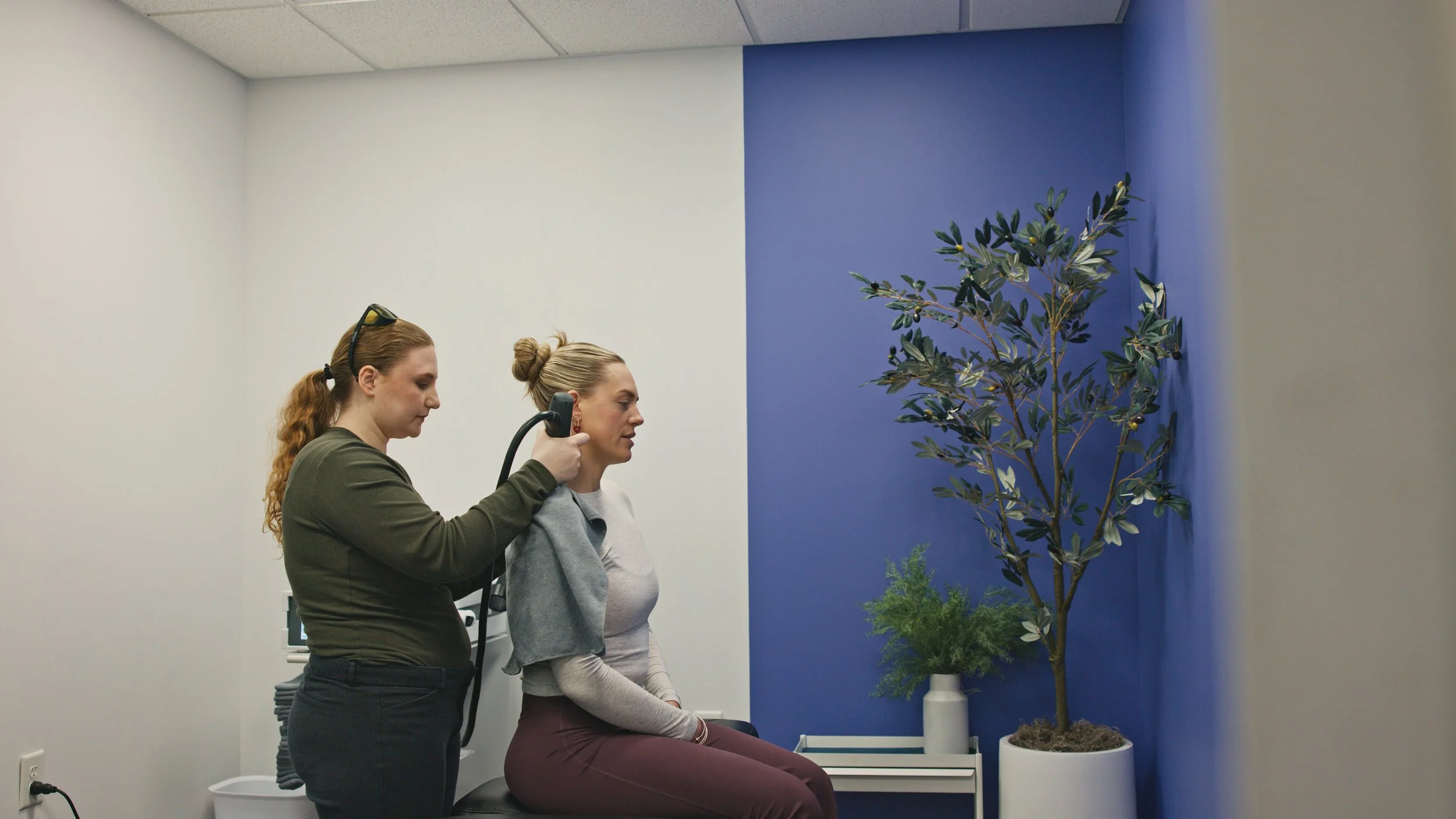
Sessions are short. Hailey, our therapy bay lead, applies the handpiece directly over the treatment area and delivers 1,000 pulses to each region, which takes 5 to 10 minutes. You will feel it working. Most patients describe the discomfort as a 3 to 4 out of 10, tolerable and over quickly. There is no downtime, and you can drive, work, and train the same day.
Treatment runs once a week because your body does the real work between sessions. Each round of pulses triggers a healing response, and the tissue needs the week to respond and recover before the next one. A standard course is 8 sessions over 2 months.
Progress gets measured, not guessed at. Your response is tracked as part of your chiropractic care, so you and the team can see whether the tissue is changing, and adjust if it is not.
Part of a bigger correction
How does shockwave fit into your care?
Shockwave is one tool, and a tool only helps when it matches the problem. Your care starts with a consultation and assessment with the doctor. If the findings point to a tendon or soft-tissue problem, focused shockwave earns a spot in your care. If the source is a disc or a joint, spinal decompression or hands-on adjustment may lead instead, and some cases call for Class IV laser therapy to calm inflamed tissue while the correction takes hold.
Not everyone needs shockwave. Every patient's care is built around your imaging and exam findings, so the mix is tailored to you, and behind every patient's care is a clinical team reviewing your progress together, not one provider working in isolation.
- 01ConsultationYou tell us what is going on, what you have already tried, and what you want to get back to.
- 02Doctor's examinationA thorough exam to identify the root cause and how we would correct it.
- 03Your findings and next stepYou hear what we found, whether we can help, and what care built around your goal would look like, with every question answered.
Your care
How does focused shockwave fit into your care?
We build care around your goal, not around appointments. Every patient's care is built around your goal and mapped out with you at your consultation and assessment, so you know exactly what your care involves before anything begins.
Have insurance questions? Every plan is different, so we do a free benefit check during your consultation and assessment. Want to know what to expect first? See our frequently asked questions.
Common questions
Common questions about focused shockwave therapy
Does focused shockwave therapy hurt?
You will feel it, and that is expected. Most patients rate the discomfort at a 3 to 4 out of 10 during treatment. Each region takes 5 to 10 minutes, and there is no downtime afterward. Many patients notice the treated area feels looser the same day.
How many shockwave sessions will I need?
Sessions are usually spaced about a week apart, because the tissue needs time to respond and recover between rounds. Your exact count depends on your findings and your goal, which we review with you before anything begins.
What is the difference between focused and radial shockwave?
Radial devices spread pressure waves broadly near the surface, which can help superficial tissue but fades fast with depth. Focused shockwave concentrates energy at a controlled depth inside the damaged structure itself. We use focused shockwave because most chronic tendon problems live deeper than a radial device can reach.
Is shockwave therapy safe?
Yes, when it is delivered by a trained team after a real exam. It is non-invasive, involves no needles or medication, and has been used for years in sports medicine and rehab settings. We screen every patient first and only recommend it when your findings support it.
Does insurance cover shockwave therapy?
Every plan is different, so we do a free benefit check as part of your consultation and assessment. Bring your insurance card to your first visit and the team will walk you through exactly where you stand before any care begins.
Do I need full course of care to get shockwave?
We start every patient with a consultation and assessment, because treating a tendon without knowing why it broke down usually means the pain comes back. If shockwave is the right tool for your case, it gets built into your care with clear milestones. If it is not, we will tell you that too.
Ready to start
See your progress, month after month
Book your New Patient Special. You will know what is going on, whether we can help, and what it would take to correct it.
You came in with a problem. You'll leave with an answer and a clear path forward.
Book New Patient Special Call (978) 961-9099★★★★★ 5.0 average rating across 150+ patient reviews · Salisbury, MA · serving Newburyport, Amesbury, Seabrook, and the North Shore