
Am I a candidate for spinal decompression? What the evaluation looks for
Spinal Decompression · Salisbury, MA
Am I a Candidate for Spinal Decompression? What the Evaluation Looks For
Spinal decompression helps a specific set of problems very well, and it is the wrong choice for others. Figuring out which group you fall into is not something you can do from a search result, but you can walk in already knowing what the evaluation is looking at and why.
This covers the conditions decompression tends to help, the medical situations that rule it out entirely, and what actually happens at your first visit before anyone recommends anything.
What conditions does spinal decompression help?
Spinal decompression works by applying gentle, controlled traction that lowers pressure inside the disc. That drop in pressure can ease what is pressing on a nerve and improve the movement of fluid and nutrients into a structure with a poor blood supply of its own.
Because of how it works, it fits problems where pressure is the core issue:
- Herniated or bulging discs where displaced material is contacting a nerve root. This is the most common reason patients end up on the table. Our page on herniated disc treatment goes deeper on that condition.
- Sciatica from disc involvement, where leg pain traces back to pressure in the lower back rather than to the leg itself. More on that in our sciatica treatment page.
- Degenerative disc changes where discs have thinned and lost height over time.
- Spinal stenosis, meaning narrowing of the space the nerves pass through.
- Nerve compression in the neck producing pain, numbness, or tingling down the arm.
The common thread is pressure on neural structures. Back pain from a muscle strain, or from a joint that has simply stopped moving well, usually calls for something else. Those cases often respond better to Chiropractic Care on its own.
Who should not have spinal decompression?
This part matters more than the candidacy list, and most articles skip it.
Several medical situations make decompression inappropriate, some of them absolutely. Traction applies force to the spine, and there are conditions where added force is the last thing the tissue needs.
Decompression is generally ruled out with: spinal fractures or recent trauma to a vertebra, advanced osteoporosis, tumors or active cancer affecting the spine, surgical hardware such as fusion implants or rods, high-grade spinal instability, pregnancy, and abdominal aortic aneurysm or significant vascular disease near the spine.
This is why imaging and a real history review come first. Some of these show up on an X-ray. Others only surface when someone asks the right question about your medical background, which is a reason to mention past surgeries, cancer treatment, or a bone density diagnosis even if it seems unrelated to your back.
If something on that list applies to you, it does not mean nothing can help. It means decompression specifically is off the table, and the conversation shifts to what else fits.
When is decompression the right next step?
Timing matters alongside diagnosis. Decompression tends to make the most sense when there is a clear pressure-related finding on imaging, and symptoms have persisted through a reasonable stretch of rest, activity change, and over-the-counter measures without meaningful improvement.
It is not usually the first thing tried for pain that started two days ago, and it is not a last resort you have to earn by suffering for a year either. If nerve symptoms are present and imaging supports it, there is little reason to wait.
What is decompression actually like?
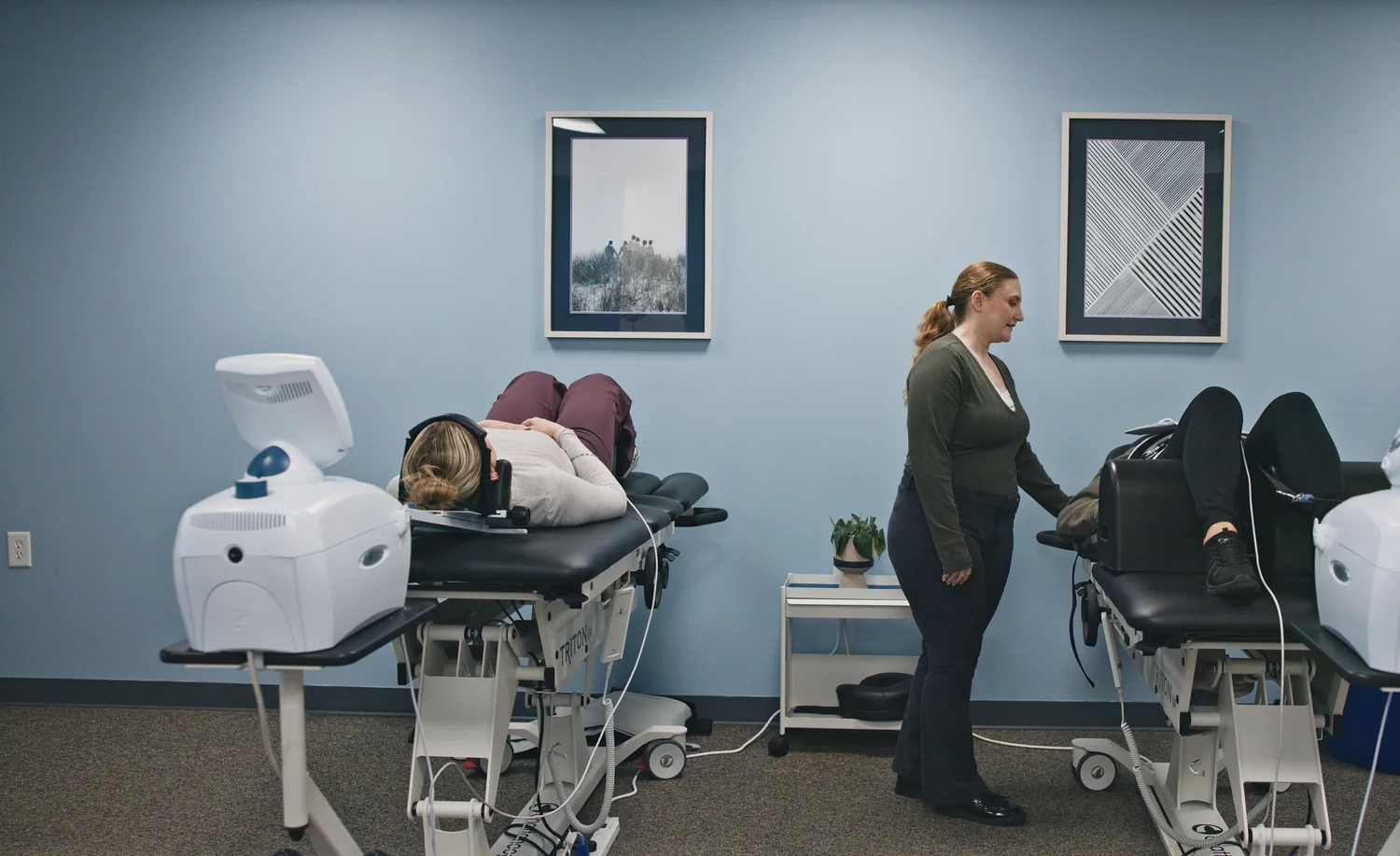
You lie on a table, fully clothed, with a harness positioned around the pelvis or supporting the neck depending on the area being treated. The table applies traction in slow cycles, easing on and releasing rather than holding a constant pull.
Most patients describe it as a stretch and find it comfortable enough that they relax through the session. Some feel mild soreness afterward, in the way a new stretch can leave you aware of an area. Sharp pain during a session is not expected, and if you feel it you say so and the settings get adjusted.
Session counts vary because the underlying conditions vary. Anyone quoting you a number before examining you is guessing. What you will get here is a recommendation based on your findings, with progress tracked so the number can be revisited as evidence comes in rather than treated as fixed.

What does the evaluation look for?
Your first visit is a consultation and assessment with the doctor, and nothing is recommended until the exam is done.
Examination
Motion X-rays, posture screening, range of motion testing, and neurological and functional movement assessment. For decompression candidacy specifically, we are looking at whether there is a pressure-related finding that matches your symptoms, whether the affected segments can tolerate traction, and whether anything in your history rules the approach out.
Clinical review
The clinical team goes through the findings together. This is not a formality. It is where imaging, exam results, and your history get read against each other, and it is often where a contraindication or a better-fitting approach surfaces.
Your findings
You get told what we found, whether we think we can help, and what a reasonable path looks like. If decompression is not right for you, we say that and explain why. If we are not the right clinic for your situation at all, we say that too and point you somewhere better.
Progress is tracked with a Spinal Health Score covering posture, nerve function, and range of motion. That gives you something objective to look at rather than judging progress week to week on feel alone.
At Newman Chiropractic the recommendation comes from your clinical picture rather than from what a benefits schedule will authorize. You will understand what care involves before you decide anything.
The short version
Spinal decompression fits pressure-related problems: disc herniations, disc-driven sciatica, degenerative changes, stenosis, and nerve compression in the neck. A specific set of medical conditions rules it out, and identifying those is the point of examining you properly first. And it is a good fit at the point where imaging supports it and conservative measures have not moved the needle.
Find out if decompression fits your situation
We see patients from Salisbury, Newburyport, Amesbury, and across the North Shore. The evaluation tells you what is actually going on and whether we can help, before care is discussed.
You can also call or text the clinic at (978) 961-9099.
Learn more about spinal decompression at our Salisbury clinic or browse the full range of conditions we work with.
