
Can a herniated disc heal without surgery? A Salisbury chiropractor explains
Disc Injuries · Salisbury, MA
Can a Herniated Disc Heal Without Surgery? A Salisbury Chiropractor Explains
You got the MRI back, the word "herniated" is sitting there in the report, and somebody has already mentioned a surgical consult. That is a frightening place to be. Here is the part that often gets lost in the conversation: most people with a herniated disc never end up in an operating room.
The body has a real capacity to break down and reabsorb displaced disc material over time. That process works better when the mechanical stress on the disc comes down and the inflammation around the nerve settles. Care that supports both of those things gives your spine a fair chance to do what it is already trying to do.
This guide walks through what the research generally supports about non-surgical recovery, how long it tends to take, what treatment actually involves, and the specific warning signs that mean you should stop reading and get evaluated right away.
Can a herniated disc heal without surgery?
For most people, yes. The general clinical picture is that a large share of herniated discs improve with conservative care, and that includes some sizable herniations causing real leg pain and numbness.
Something that surprises a lot of patients: the size of the herniation on your imaging is a poor predictor of whether you will need surgery. Big herniations sometimes resolve well. Smaller ones occasionally cause stubborn symptoms. What your scan looks like and how you actually feel are two different questions, and they do not always line up.
Surgery is a real option and it helps the right patients. It is just not the automatic first step that many people assume it is when they hear the diagnosis.
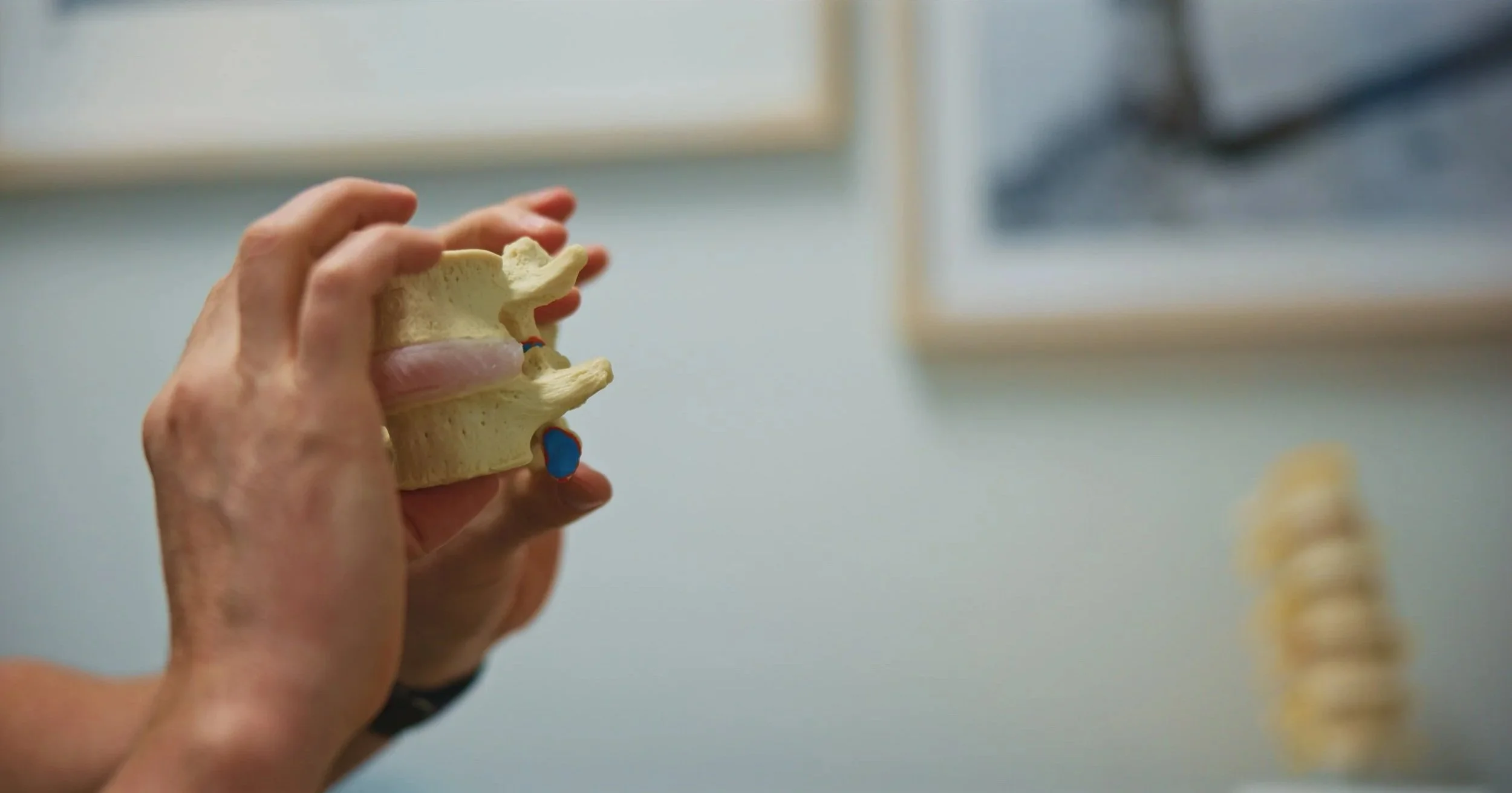
What is actually happening inside a herniated disc?
Your discs sit between the vertebrae and work as cushions. Each one has a tougher outer ring and a softer center. A herniation happens when some of that inner material pushes through a weak spot in the outer ring.
The pain usually has two sources working together. There is mechanical pressure, where displaced material presses on a nearby nerve root. And there is chemical irritation, because the material that leaks out is inflammatory to nerve tissue on contact. That second piece explains something patients find confusing, which is why a small herniation can hurt so much.
It also explains why some people improve substantially before their imaging changes at all. Calm the inflammation down and the nerve stops firing the way it was, even if the disc still looks similar on a scan.
How long does a herniated disc take to heal?
Recovery timelines vary widely, and anyone who gives you a single number without examining you is guessing.
What we can say is that the variables driving your timeline are fairly consistent:
- How much material has displaced and where it sits relative to the nerve.
- How long symptoms have been present before care started.
- Whether the nerve is still under active compression or has begun to settle.
- Your age and general health, which affect tissue repair.
- How consistently you follow through once care begins.
That last one matters more than most people expect. Two patients with nearly identical imaging can land in very different places six months out, and the difference usually comes down to consistency rather than the severity of the original injury.
At Newman Chiropractic we track progress with a Spinal Health Score, which measures posture, nerve function, and range of motion. It gives you something concrete to look at instead of relying only on how a given week happened to feel. Some weeks feel worse than others during recovery. Measurement keeps that from being mistaken for a setback.
Will a bulging disc go back on its own?
Sometimes, and this is worth being precise about because bulging and herniated get used interchangeably when they are not the same thing. A bulge means the disc extends past its normal border while the outer ring stays intact. A herniation means material has broken through.
Bulges are common and often cause no symptoms whatsoever. Plenty of people have them and never know. When a bulge does become painful, it frequently settles down on its own within several weeks.
The catch is what happens next. Waiting alone does nothing about whatever caused the disc to bulge in the first place, and that cause is usually mechanical, things like how you sit, how you lift, or a spine that has lost its normal curve. If the underlying loading pattern stays the same, the problem tends to come back. That is the difference between symptoms quieting down and the situation actually being addressed.
What does non-surgical herniated disc treatment involve?
Effective care works on several fronts at once, because disc pain has several sources at once. Here is what we use at our Salisbury clinic and what each piece is for.
Chiropractic adjustments
Chiropractic Care restores motion to spinal joints that have stiffened up. When segments above and below the injured disc move properly again, the load spreads across the region instead of concentrating on the damaged level.
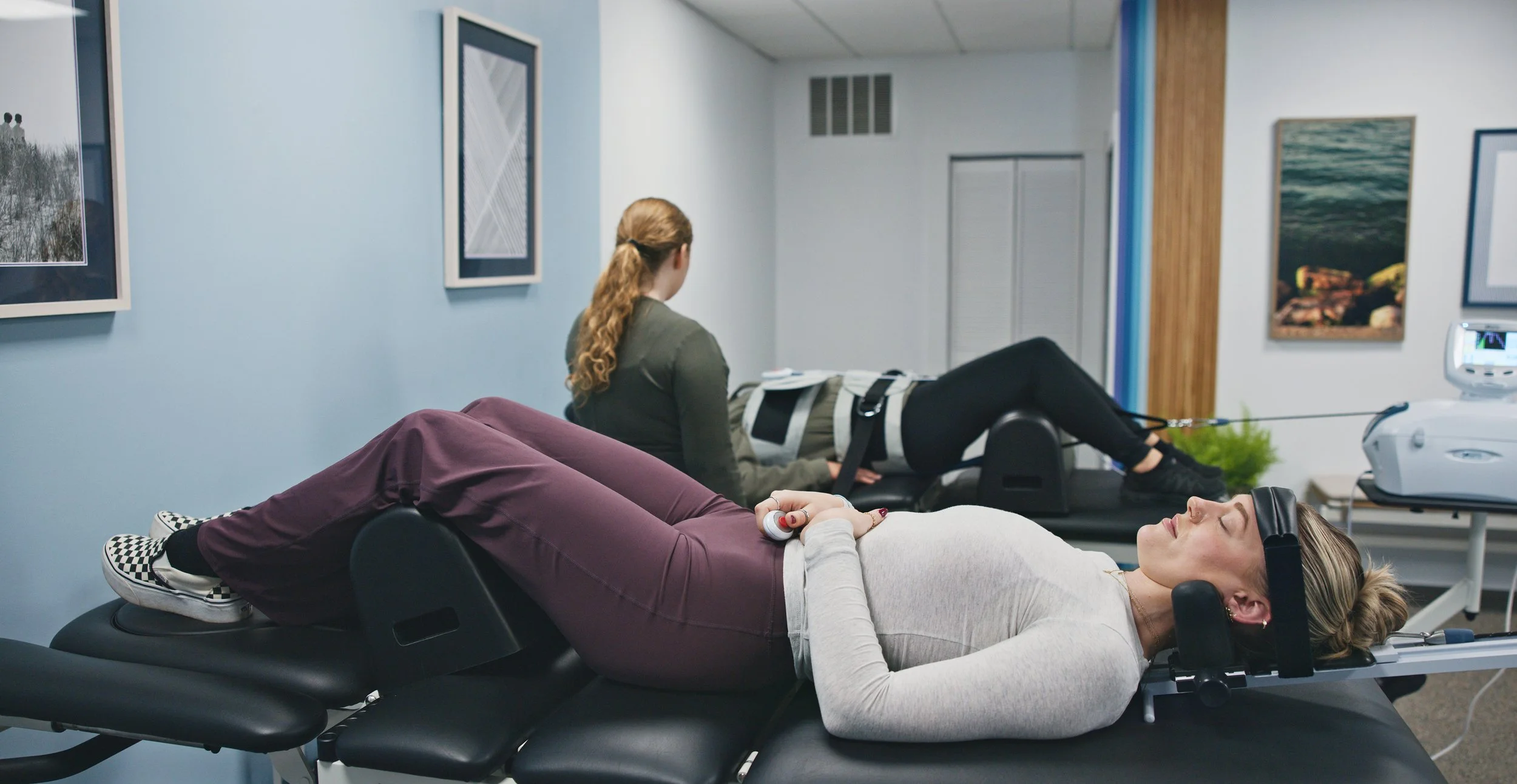
Spinal decompression
Spinal decompression is usually the centerpiece for disc patients. The table applies a gentle, controlled stretch that lowers pressure inside the disc. That drop in pressure can help draw displaced material inward and improves the flow of fluid and nutrients into a structure that has a poor blood supply of its own.
Class IV Medical Grade Laser
Laser therapy delivers energy into deeper tissue to support cellular repair and bring down inflammation around the irritated nerve. Since inflammation drives so much of the pain, calming it changes how the area feels well before structural healing finishes.
Focused Shockwave
Focused Shockwave is for cases where things have been going on a while. Long-standing injuries often develop soft tissue changes that stop responding to standard care. Shockwave stimulates that stalled tissue and gets a repair response moving again.
Not everyone needs all four. What you receive depends on your findings and what you are trying to get back to.
When is surgery actually the right call?
Some situations need a surgeon, and knowing them matters more than anything else on this page.
Get emergency care immediately if you have loss of bladder or bowel control, numbness through the groin or inner thighs, or sudden weakness in both legs. These can indicate cauda equina syndrome, which is a surgical emergency where delay causes permanent damage.
Get evaluated promptly, though not emergently, if you have muscle weakness that is clearly getting worse, a foot that drops or catches when you walk, or severe pain that has not responded at all to well-structured conservative care over a reasonable period.
Outside of those situations, conservative care is generally the reasonable first step. A surgeon who is worth seeing will tell you the same thing.
What happens at your first visit?
Your first visit is a consultation and assessment with the doctor.
The first visit is examination. Motion X-rays, a posture screen, range of motion testing, and neurological and functional movement assessment. We are building a clear baseline of what is happening structurally.
Then comes the conversation. You get told what we found, whether we think we can help, and what a realistic path looks like for your situation. If we do not think we are the right fit, we say that and point you somewhere better.
At Newman Chiropractic we answer to your clinical picture rather than to what a benefits schedule will authorize. Your care gets built around your goal. Somebody recovering from a spinal fracture and somebody who wants to get back on the water this summer need different things, and pretending otherwise helps nobody.
The short version
Most herniated discs improve without surgery. The size of the herniation on your imaging tells you far less than people assume. Recovery timelines depend heavily on how early you start and how consistent you are. And a handful of specific symptoms genuinely do require prompt medical attention.
If you are somewhere between a diagnosis and a surgical consult and want a clearer read on your options, that is exactly what the evaluation is for.
Talk with our Salisbury team
We serve patients across Salisbury, Newburyport, Amesbury, and the surrounding North Shore. If a herniated disc is limiting what you can do, start with the evaluation and get real answers about your spine.
You can also call or text the clinic at (978) 961-9099.
You can read more about our approach to herniated disc treatment or browse the full range of conditions we work with. If your symptoms include pain traveling down one leg, our page on sciatica treatment covers how the two are connected.
